
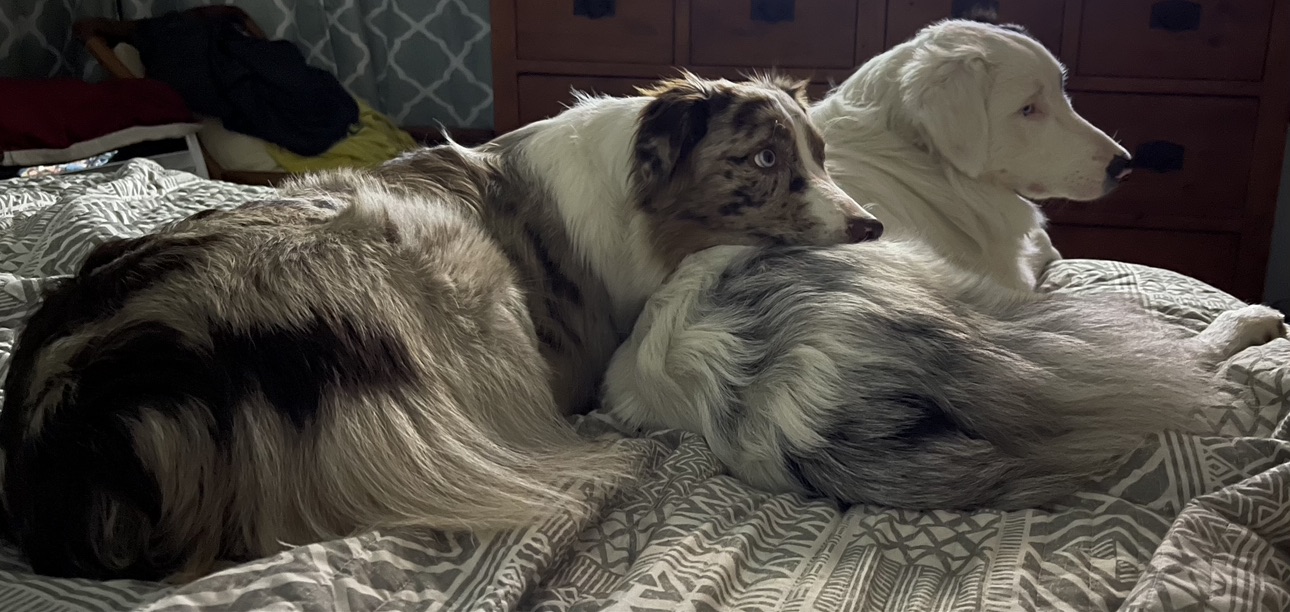
What my dogs taught me about resentment
I’m a dog person and have been all my life. One of the things my dogs have taught me is that they carry expectations just like we do. Grab a leash or mention a walk and my dogs will jump, wag, yip in the happy expectation that we are going for a walk. So, if I’m moving the leash for convenience, as I reach for something else, my dogs see my movement and anticipate a walk. They have an expectation in that moment that we are walking. Or, if I’m talking to a friend on the phone about an upcoming walk and I happen to say the word out loud (without spelling w-a-l-k) you can feel the expectation register. And, when it becomes obvious that no leash or walk is on the agenda, my pups begin to groan in protest. They moan, pace, lie by the front door with nose at the threshold, all because they had the expectation that we were walking and they are committed to that story.
And once it is truly clear that no walk is taking place, they don’t pretend they never wanted the walk. They don’t decide I’m selfish and bark at or bite me. They don’t tell themselves they shouldn’t have expected anything. They don’t silently keep score for three weeks and give me the cold shoulder.
This Substack is reader-supported. To receive new posts and support my work, consider becoming a free or paid subscriber.
They feel disappointed. They express that disappointment in body language and behavior, then, remarkably, they move on.
Dogs seem extremely comfortable with both expectation and disappointment. They don’t hide either one. They expected a walk. They didn’t get one. They let me know exactly how they felt!
Now, five minutes later, the expectation and disappointment have been expressed and processed, and they’re stretched out in a patch of sunlight, fully returned to the present.

Humans seem to do something else entirely. We hide the disappointment, convince ourselves we shouldn’t have expected so much, tell ourselves we’re fine, and somewhere along the way begin calling it something else. We call it frustration, irritation, distancing, burnout, cynicism. We’ll happily call it anything but what it is…. Which is big “D,” disappointment.
I’ve long thought that resentment is what disappointment becomes when it isn’t acknowledged. It’s subtle. It doesn’t announce itself overtly. I don’t think resentment is forged from negativity. I think resentment is born when hope collides with reality and the disappointment goes unnamed.
Disappointment rarely announces its approach or presence. But it is felt when:
• The spouse isn’t who we once imagined they’d become.
• The business never reached the size we expected.
• The child grew up, living an adult life that looks very different than what we hoped for.
• The friendship that satisfied once, slowly becomes one-sided.
• The body doesn’t cooperate anymore.
• The career stopped feeling meaningful.
Disappointment is harder on us than we like to admit. It asks us to confront the gap between the future we imagined and the reality in front of us. It asks us to let go of something we were counting on, something we had already begun living.
For years I’ve worked with people who are remarkably disciplined. They know how to push forward, stay positive, solve problems, and keep moving. Those strengths serve them well…until disappointment arrives. Because disappointment doesn’t respond to discipline. It asks something entirely different. It asks to be acknowledged before it can be released.
So why do humans deny disappointments while dogs don’t? Dogs don’t attach disappointment to profound meaning, loss or identity. Humans do. We experience disappointment as evidence against ourselves. We chose poorly, did something wrong, were too naive or sensitive. We try to talk ourselves out of our expectations and even shame ourselves for it.
Dogs remind me that disappointment doesn’t have to become resentment. It can simply be disappointment. A hope that didn’t come to pass is impermanent. It’s temporary if I acknowledge it. A future that didn’t unfold the way we imagined isn’t something to resent. It’s something worth acknowledging before we move on.
I wonder what would change in our relationships if we became as honest about our disappointments as dogs are. Perhaps resentment isn’t evidence that we expected too much. Perhaps it’s evidence that we never gave ourselves permission to mourn what we expected in the first place.
Leave a Reply